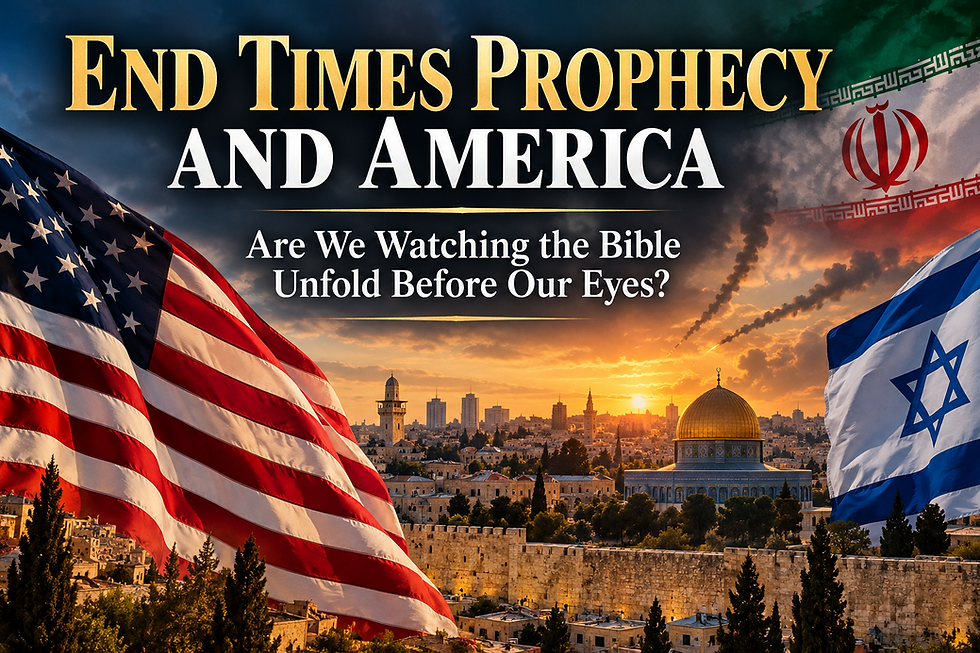
End Times Prophecy and America: Are We Watching the Bible Unfold Before Our Eyes?

By Tedd ClaytonHope for the Journey | October 20, 2026
Are the conflicts involving Iran, Israel, and the United States connected to biblical prophecy? And what do these events mean for Christians living in America today?
Turn on the television, scroll through social media, or read the latest headlines, and one thing becomes painfully clear: our world is experiencing tremendous uncertainty.
Wars, political tensions, economic instability, and international conflicts dominate the news. For many Americans, these developments bring a growing sense of uneasiness about what tomorrow might hold.
But for Christians who study Bible prophecy, the events unfolding in the Middle East raise another important question:
Could we be witnessing events that will ultimately lead to the return of Jesus Christ?
It's a question worth examining—not through fear or sensational headlines, but through the Word of God.
And perhaps more importantly, we need to ask what all of this means for Americans today.
The Middle East: Why Iran and Israel Matter
The relationship between Iran and Israel has been a source of international tension for decades. But the military confrontations and regional instability of recent years have brought these concerns into sharper focus.
As of October 20, 2026, tensions remain serious.
On October 19, U.S. Defense Secretary Pete Hegseth made an unannounced visit to the Middle East and reportedly met with Israeli Prime Minister Benjamin Netanyahu.
Meanwhile, Iran-backed Houthi forces in Yemen have continued attacks across the region, and renewed concerns about military operations against Iran have complicated diplomatic efforts. These developments underscore how interconnected the region's conflicts have become. AP News
For Americans, these are not simply distant events.
Military involvement in the Middle East raises concerns about the safety of American service members. Instability near important shipping routes can create uncertainty for international trade and energy markets.
And for families already dealing with financial pressures, the possibility of additional economic disruption is troubling.
Yet when we examine the Bible, the significance of this region goes far beyond economics and national security.
Israel occupies an important place in biblical history and prophecy.
That brings us to one of the most frequently discussed prophetic passages in Scripture.
Ezekiel 38: Does the Bible Mention Modern-Day Iran?
In Ezekiel chapters 38 and 39, the prophet describes a future confrontation involving a coalition of nations coming against Israel.
One particular verse has attracted considerable attention among Bible prophecy teachers.
Ezekiel 38:5 (NKJV) includes Persia among the nations participating in this coalition.
Why is that significant?
Because Persia is the historical name associated with the territory of modern-day Iran.
The country officially adopted the name Iran for international use in 1935, although the name Iran itself has much older roots.
Some Christians believe Ezekiel's prophecy describes a future military alliance that will attack Israel during the last days.
They see the modern hostility between Iran and Israel as potentially significant.
Others interpret Ezekiel's prophecy differently, including those who understand its language in relation to ancient historical conflicts or symbolic portrayals of God's ultimate victory over evil.
We should recognize those differences rather than claim certainty where Scripture's interpretation remains debated.
The important distinction is that the Bible's reference to Persia does not, by itself, prove that today's Iranian conflict fulfills Ezekiel 38.
Nevertheless, these events can encourage us to study Scripture carefully and consider what the Bible teaches about God's purposes in history.
Jesus Warned Us About Wars and Rumors of Wars
Perhaps one of the clearest teachings concerning the end times comes directly from Jesus.
In Matthew chapter 24, His disciples asked about the signs of His coming and the end of the age.
Jesus described a world experiencing considerable turmoil.
Matthew 24:6 (NKJV) tells us:
"And you will hear of wars and rumors of wars. See that you are not troubled"
Think about those words for a moment.
Jesus did not say there would never be wars.
He did not promise that nations would always coexist peacefully.
Instead, He warned that wars and international conflicts would occur.
But notice something extremely important.
Jesus specifically instructed His followers not to be troubled.
That does not mean we should ignore suffering, violence, or threats to human life.
It means that our confidence in God should not disappear whenever the world becomes unstable.
Jesus also warned that these events would not necessarily mean the end had immediately arrived.
Throughout history, Christians have witnessed devastating wars and believed that the end was near.
The two world wars, conflicts surrounding Israel's modern establishment, and numerous Middle Eastern crises have all generated considerable prophetic speculation.
Yet history reminds us that identifying the precise timing of Christ's return is not something we can accomplish by examining headlines alone.
The challenge is to remain watchful without becoming fearful.
Why Israel Continues to Be Central to Bible Prophecy
To understand why Christians pay such close attention to Israel, we must understand its biblical significance.
God's covenant with Abraham, recorded in Genesis 12 and subsequent chapters, established a special place for Abraham's descendants in biblical history.
Jerusalem also occupies an important role throughout Scripture.
The prophets Isaiah, Jeremiah, Ezekiel, Daniel, and Zechariah speak extensively about Israel, Jerusalem, judgment, restoration, and God's ultimate purposes.
In Zechariah chapter 12, Jerusalem becomes the focus of intense international conflict.
Many prophecy teachers believe these passages point toward events preceding the return of Jesus Christ.
Other Christian traditions understand portions of these prophecies as fulfilled through Christ, the early church, or historical events.
These differences deserve thoughtful study.
Regardless of our prophetic interpretations, one truth remains clear:
God calls His people to seek righteousness, pursue peace, and demonstrate compassion.
Supporting the safety and dignity of Israeli civilians should not require indifference toward Palestinian civilians or the suffering of ordinary Iranian families.
Human life matters.
And Christians should never allow discussions about prophecy to diminish their compassion for people caught in war.
What Does All This Mean for the United States?
Now we arrive at the question that may matter most to readers of Hope for the Journey.
How do these international events affect Americans?
There are several important considerations.
1. America Is Not Immune to Global Conflict
It is easy to believe that wars occurring thousands of miles away have little effect on our daily lives.
But the modern world is deeply interconnected.
Disruptions to energy supplies and international shipping can affect businesses, transportation, and household expenses.
Military conflicts may also create new security challenges and diplomatic pressures.
For Americans, these developments are reminders that earthly stability can never be guaranteed.
In Matthew 6:34, Jesus teaches us not to become consumed by worry about tomorrow.
That teaching does not excuse us from responsible planning.
Rather, it reminds us that anxiety should not control our lives.
2. Political Leaders Cannot Guarantee Lasting Peace
Americans naturally look to elected officials and international leaders for answers during times of crisis.
Diplomacy, negotiations, and responsible leadership are important.
But Scripture reminds us that our ultimate hope cannot rest entirely upon human governments.
Psalm 146:3–5 warns against placing absolute confidence in earthly rulers and instead directs our hope toward God.
Governments change.
Alliances shift.
International agreements sometimes succeed and sometimes fail.
But God's character does not change.
As Christians, we can remain informed and engaged citizens while recognizing that our deepest security comes from our relationship with the Lord.
3. Difficult Times Can Reveal Where We Place Our Trust
Think about the uncertainty many Americans are experiencing.
Families are concerned about finances.
Parents wonder what kind of world their children will inherit.
Military families worry about loved ones serving overseas.
And many older Americans wonder whether they will witness another major international war.
These concerns are understandable.
But difficult circumstances can also reveal the foundation upon which we've built our lives.
Are we depending entirely upon political stability?
Are we placing all our confidence in financial security?
Or are we building our lives upon something that cannot be shaken?
Jesus teaches in Matthew 7:24–27 that a life built upon His teachings is like a house constructed upon rock.
Storms still come.
Winds still blow.
Rain still falls.
But the foundation remains.
Our faith does not prevent every storm. It gives us a foundation strong enough to withstand them.
Are We Actually Living in the End Times?
This is the question that brings everything together.
Could we be living in the generation that witnesses the return of Jesus Christ?
From a Christian perspective, His return is a central promise of Scripture.
Acts 1:11 speaks of His future return.
First Thessalonians 4:16–18 offers believers encouragement concerning the coming of the Lord.
Revelation 22:20 concludes with an expression of longing for Christ's return.
But can anyone establish that His return will happen because of a specific conflict between Iran and Israel?
No.
Scripture does not give us permission to declare a date or identify every contemporary military confrontation as a fulfilled prophecy.
In Matthew 24:36, Jesus makes clear that the precise day and hour are not known to humanity.
That should encourage humility in how we interpret world events.
We can acknowledge developments that appear significant.
We can study prophetic Scripture.
We can recognize that conflict in the Middle East deserves our attention.
But we must distinguish between what the Bible actually says and what we believe today's events might mean.
Being spiritually prepared is far more important than attempting to predict the exact timing of Christ's return.
Five Things Christians in America Should Be Doing Right Now
Rather than allowing the news to overwhelm us, I believe there are practical ways Christians can respond.
First, strengthen your relationship with God.
Spend time in prayer and Scripture. Don't depend entirely upon social media commentators or prophecy teachers to explain the Bible.
Read the passages yourself.
Ask the Lord for wisdom and understanding.
Second, pray for peace and those affected by war.
Pray for Israel.
Pray for the people of Iran.
Pray for Palestinian families and others suffering throughout the region.
Pray for American service members and their loved ones.
And pray that leaders will seek solutions that protect innocent lives.
Third, be careful about what you believe and share.
Not every dramatic headline is accurate.
Not every video circulating online tells the entire story.
And not every person claiming to understand prophecy is interpreting Scripture responsibly.
Before sharing information, consider its source and whether the claims can be verified.
Fourth, encourage those who are afraid.
Someone in your family may be genuinely worried about the future.
A neighbor may be struggling financially.
A friend may be frightened by the possibility of a wider war.
Sometimes the most meaningful Christian response isn't delivering a lengthy explanation of prophecy.
It's simply reminding someone that they are not alone.
Fifth, live as though every day matters.
Forgive someone.
Encourage someone.
Share your faith.
Help a person in need.
Tell your family you love them.
Don't postpone the things that matter most because you assume you'll always have another tomorrow.
The uncertainty of the future should encourage us to live with greater purpose today.
The Greatest Prophecy Is Also Our Greatest Hope
When people discuss the end times, the conversation often revolves around frightening events.
Wars.
Earthquakes.
Economic turmoil.
Political upheaval.
The Antichrist.
The Great Tribulation.
But sometimes, amid all these discussions, we overlook the central message of Christian hope.
Jesus Christ is coming again.
For believers, the return of Christ is not merely a warning about coming judgment.
It is also the promise of ultimate restoration.
In Revelation 21:4, Scripture describes a future in which God brings an end to death, sorrow, crying, and pain.
Imagine that.
A world without war.
A world without suffering.
A world without families grieving the loss of loved ones.
A world where fear no longer dominates the human experience.
That is the hope Scripture places before us.
And it is far greater than anything today's political leaders or governments could ever accomplish.
Final Thoughts: Don't Let the Headlines Steal Your Hope
As I look at the events unfolding around the world, I understand why so many Americans are concerned.
The conflict involving Iran, Israel, and the United States deserves serious attention.
The potential consequences for our country deserve thoughtful consideration.
And the biblical passages concerning the last days deserve careful study.
But I want to leave you with something more important than any prediction about what might happen tomorrow.
God has not called us to live in constant fear of the future.
He has called us to remain faithful.
To love one another.
To pursue peace.
To stand firm in our faith.
And to trust Him even when we cannot understand everything happening around us.
Are we approaching the final days before the return of Jesus Christ?
Perhaps.
But no one can establish that conclusion simply by comparing today's headlines with biblical prophecy.
What we can know is that every passing day brings us closer to the fulfillment of God's ultimate purposes.
So instead of asking only, "How much time do we have left?" perhaps we should also be asking:
"What am I doing with the time God has given me?"
Because whether Christ returns tomorrow or generations from now, the responsibility of every believer remains the same.
Love God.
Love others.
Remain faithful.
And never surrender your hope.
The world may change overnight, but the promises of God remain.
And that, my friend, is something worth holding on to.
A Prayer for Our Nation and Our World
Heavenly Father,
We come before You today recognizing that our world is filled with uncertainty.
We see wars, hear threats of conflict, and watch nations struggle to find peace.
Lord, we pray for the people of Israel, Iran, and every nation affected by violence and unrest.
Protect the innocent. Comfort grieving families. Give wisdom to those making decisions that affect millions of lives.
We pray for the United States and for our military personnel serving around the world.
Most importantly, Father, help us remember that our hope is not found in political leaders, military power, or worldly security.
Our hope is found in You.
Give us the wisdom to understand Your Word, the courage to remain faithful, and the compassion to love others even during difficult times.
When fear begins to overwhelm us, remind us of Your promises.
Help us live each day with purpose, knowing that tomorrow is in Your hands.
In the precious name of Jesus Christ, we pray.
Amen.
A Final Word from Hope for the Journey
You don't have to understand every prophecy or predict every world event to have confidence in God's promises.
Whatever tomorrow brings, remember that you do not have to face it alone.
Keep the faith. Keep encouraging others. And keep looking toward the hope we have in Jesus Christ.
Because no matter how uncertain the world becomes, there is always hope for the journey.
— Tedd Clayton
Hope for the Journeywww.hopeforthejourney.us
Scripture References
New King James Version (NKJV)
Genesis 12:1–3 — God's covenant with Abraham
Psalm 146:3–5 — Trusting in God rather than earthly rulers
Ezekiel 38–39 — Gog, Magog, Persia, and Israel
Zechariah 12 — Jerusalem and the nations
Matthew 6:34 — Do not worry about tomorrow
Matthew 7:24–27 — Building upon a firm foundation
Matthew 24:3–36 — Signs of the times and Christ's return
Acts 1:11 — The promise of Jesus' return
1 Thessalonians 4:16–18 — The coming of the Lord
Revelation 21:4 — The promise of a world without sorrow
Revelation 22:20 — The promise of Christ's coming
Current-Events Sources
Reporting consulted for the October 20, 2026 context:


Comments